Forensic species identification by DNA barcode, from specimen to statement.
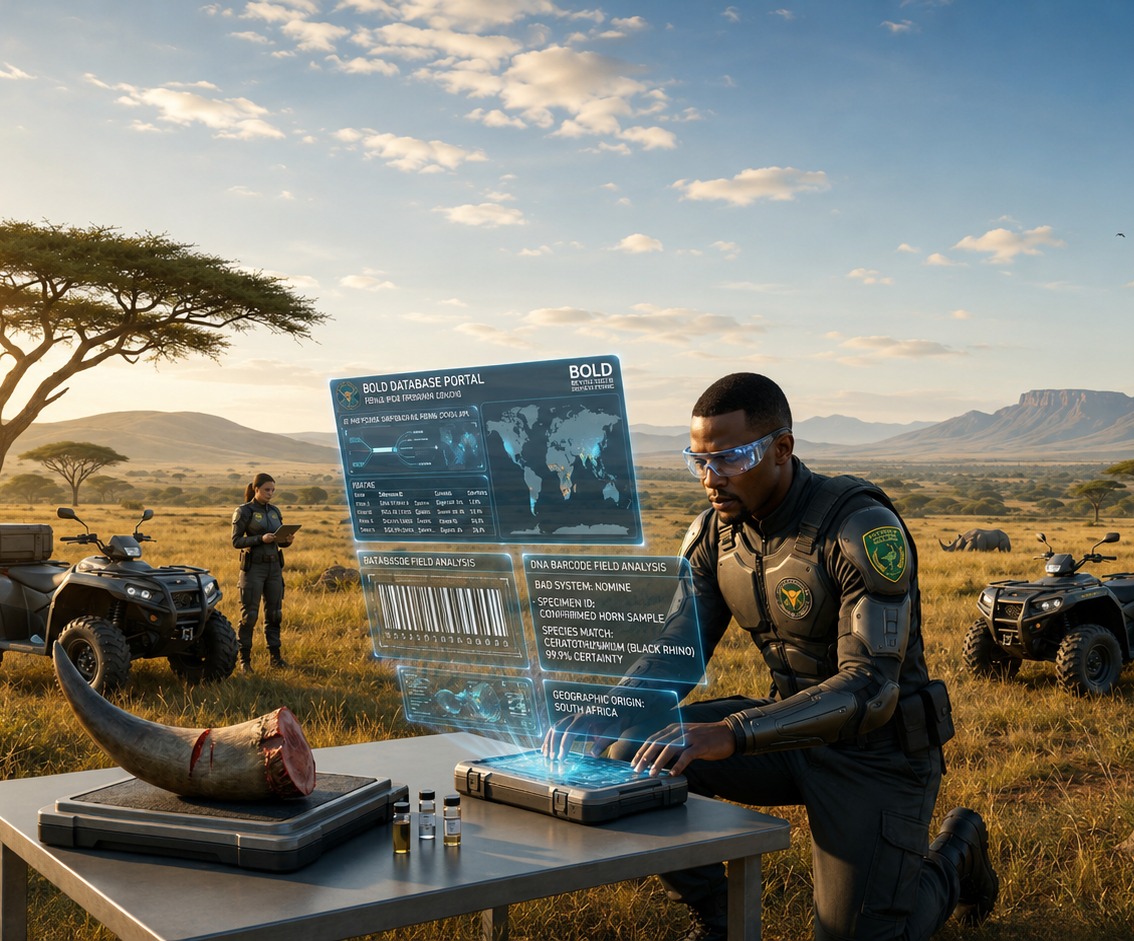
BF Workbench keeps specimen records, DNA sequences and their supporting evidence together, and runs the analyses used to identify species from them. It is used in wildlife compliance and enforcement work, where an identification may need to stand up as evidence.
- Maintained by
- Biolytica
- Reference data
- BOLD reference libraries, searched with BLAST
- Record standard
- Barcode Core Data Model (BCDM) with a forensic extension
- Access
- Registered accounts, with a separate access list for each project
DNA barcoding
Species can be identified from a short, standard region of their DNA. The barcode below is that region from a black rhinoceros.
COI-5P barcode of the black rhinoceros (Diceros bicornis), from public BOLD record GBMA15010-17 (GenBank KX012668), 658 bases. Each vertical bar is one nucleotide.
What a DNA barcode is
A 658-base region of the mitochondrial COI gene, sequenced the same way for every animal species. It differs between species but varies little within one, so an unknown sequence can be matched against a reference library of identified specimens.
The problem it solves
Seized material often cannot be identified by eye: horn, meat, skins, scales, eggs, early life stages and look-alike species. A barcode identifies the species from a small tissue sample, without a specialist for every group, and another laboratory can repeat the test.
Why it matters for wildlife crime
Whether a product may be possessed or traded often depends on its species, under CITES and national law. An identification used in a prosecution must rest on a documented method and traceable reference records. Where a single animal must be identified, as with rhino horn, a microsatellite genotype can link the sample to it.
From specimen to identification
Work in the workbench follows the order in which forensic evidence is produced. Each stage adds to the same record, so an identification can be traced back to the specimen and the material it came from.
-
Register the specimen
Record where, when and by whom the sample was collected, its taxonomy, and the seal, kit and tag numbers that tie it to the physical evidence. Enter records one at a time or upload a completed template.
-
Attach supporting evidence
Add specimen photographs, chain-of-custody records, permits and statements. Each file is checked against its type when it is uploaded.
-
Add sequence data
Upload sequences, trace chromatograms and supporting reads. Each is linked to its specimen by process ID.
-
Run analyses
Select records and choose a method. The job runs in the background and returns a report with tables, charts and files to download.
-
Review and report
Check each result against the specimen record and its evidence, then prepare an expert statement from the record and the analyst's registered qualifications.
Integrated analytical methods
Analyses run on the records selected in a project or dataset. Each method has its own parameters, such as marker, alignment and minimum sequence length, and returns a report with tables, charts and downloadable results.
| Method | Question it answers | How it works |
|---|---|---|
| Identification | Which species does this sequence most closely match? | Searches each sequence against a selected BOLD reference library using BLAST, in two passes at different identity thresholds, and returns the closest matches with a taxonomic assignment and confidence. |
| Distance summary | How much do sequences differ within and between taxa? | Calculates pairwise Kimura two-parameter (K2P) distances, with optional MAFFT alignment, and summarises them at species, genus and family level. |
| Barcode gap | Can the species in this set be told apart by distance? | Compares the largest distance within each species with the distance to its nearest neighbouring species, and flags species where the two overlap. |
| Diagnostic characters | Which positions distinguish closely related species? | Finds nucleotide positions that are consistent within a species and differ from its relatives, without relying on a distance threshold. |
| Phylogenetic tree | How are these sequences related? | Aligns sequences with MAFFT and builds trees with FastTree, RAxML or IQ-TREE. Trees are drawn in five styles and supplied as PDF. |
| Sequence composition | Is base composition consistent across taxa? | Calculates nucleotide frequencies by taxon, to support model selection and to find records with unusual composition. |
Sequences and specimen data can also be exported as packages for use in other software.
Community standards-based data model
Records follow the Barcode Core Data Model (BCDM), the community standard for DNA barcode data, aligned with the Barcode of Life Data System (BOLD) and mapped to Darwin Core. BOLD Forensics extends it with fields for forensic handling: seals, kits, custody, storage and individualisation. Files that support a record are stored with it.
Specimen record
- Specimen
- Sample, field and museum identifiers; sex, life stage and tissue type
- Collection event
- Date, locality and coordinates; collectors, habitat and sampling protocol
- Taxonomy
- Identification from kingdom to species, with the identifier, method and confidence
- Sequence
- Marker, nucleotide sequence, primers, sequencing site and INSDC accession
- Forensic handlingForensic extension
- SAPS sample-seal reference, sealed-bag identifiers and contents, collection kit and specimen tag, biobank catalogue number, collector details and method of delivery
- IndividualisationForensic extension
- Microsatellite genotype, where an individual animal must be matched
Supporting files
Documents
- Chain-of-custody records
- Collection statements
- Evidence seal-break statements
- Analyst statements
- Taxonomic identification reports
- Permits
- Lab worksheets and notebooks
- Scientific papers
Sequence data
- FASTA sequences
- Trace chromatograms (AB1, SCF)
- Supporting reads (FASTQ)
- Sequence alignments
- Genetic fingerprints (FSA)
Images
- Specimen photographs, with generated thumbnails
Custody and access
The workbench handles material whose provenance may need to be demonstrated. These controls apply to every project.
Access is granted per project
Records sit in projects and datasets, each with its own access list. Accounts are given read, edit or manager rights, and records are never shown to visitors who are not signed in.
Activity is recorded
Activity on each project and dataset is logged against the account responsible and summarised on an oversight dashboard.
Files are kept as received
Each uploaded file is checked against its type and stored with a checksum taken at upload. Previews and thumbnails are made separately, so the original is not altered.
Systems connect with issued keys
Other systems reach the platform through its API, using keys issued to named clients by an administrator.
Documentation and support
-
Documentation
How to work with projects, records, uploads and analyses.
-
Identification engine
How sequences are matched against the BOLD reference library.
-
Frequently asked questions
Common questions about access, records and exports.
-
About the platform
What the platform is for and how it is organised.
-
Support
How to report a problem or ask for help with access.
-
API reference
Endpoints for systems connecting with an issued key.
-
System status
Current availability of each platform service.
-
Request an account
Email [email protected] to request access to the workbench.
Origins and partners
BOLD Forensics was developed as a GEF-7 project, funded by the Global Environment Facility and supported by the United Nations Environment Programme, in close collaboration with South Africa's Department of Forestry, Fisheries and the Environment and the South African National Biodiversity Institute. Biolytica designed and built the platform and maintains it.
The work draws on the African Centre for DNA Barcoding at the University of Johannesburg, and on the Veterinary Genetics Laboratory at the University of Pretoria, which developed the RhODIS system for identifying individual rhinos from their DNA.